Saturday, June 23, 2012

The Bruiser


Two teas from Bulang today.  Two toughs.  One young and the other a precocious teenager.  Both admirable and husky and just what I needed.  I overdid it.

I'm always awed by the distinctive bitterness of Bulang teas:  thick and centered in the back of the throat.  It somehow manages to punch without being harsh.  A bone crusher rather than a lacerator.  

I think Essence of Tea won in the Bulang department this year.  I never tried last year's offering, but the 2009 and 2010 cakes have been shelved in the hope that time will take their edges off.  In fact, these teas might be the only ones that survive the dry climate here.  We'll see.  The 2012 Bulang is excellent, still quite a brute, but drinkable now if one is careful about leaf/water proportions.  I went overboard with leaf today and could only finish 5 or 6 pots.  The bitterness lasts in the throat and mingles with a lingering sweetness.  This tea has stamina.

For comparison, I broke out the last of a sample of the Heng Li Chang Bulang bing and alternated cups.  I've never sipped an older and younger tea back to back like this and it was quite the contrast:  the crisp and fragrant hammering of the younger tea and the sweet, thick, rounded depths of the 1997 cake.  The quality of bitterness is very much the same in both while being diminished in potency in the older cake. 


I wouldn't drink tea like this often because I think the specific qualities of both teas got submerged in the combination.  But what the hell.  It impressed upon me just how wonderful it is to drink great, meaty, carefully aged sheng pu.  Truly a delight.  I wish I could drop the $180.00 for a full bing of the Heng Li Chang.  I'm sure that's reasonable for a tea of this caliber, I just don't have the spare change.  After today's session I went on the EoT site and tried to order 100 and then 60 and then 40 g more of the tea to no avail.  Maybe one can only order up to 20g in lieu of a full cake.  Maybe they're out of samples.  All I know is that, for good or ill, this tea has become a benchmark for me and I'm going to miss it.

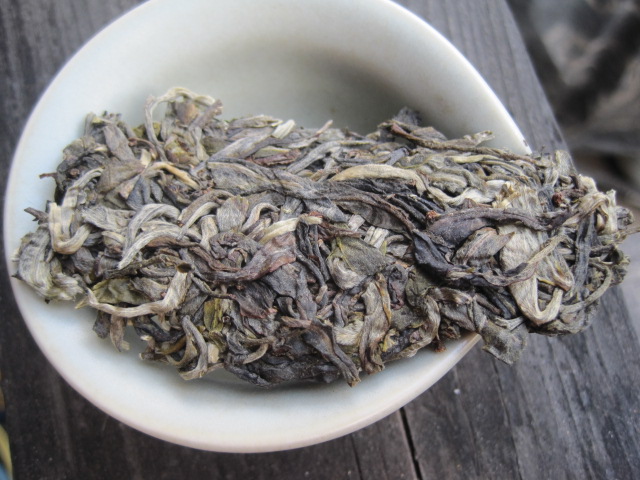
Heng Li Chang Bulang
  
Essence of Tea 2012 Bulang


Sunday, June 17, 2012

Green Things

I don't know if it's the cold spring or whether there are changes afoot with my body's preferences, but I'm having trouble downing the rawer teas of the 2012 spring season.

It happened first with the fabulous range of fresh lu cha from Gingko.  Great teas, beany longjings and ethereal mao fengs.  Lovely teas.  I just don't find myself stuffing them in the gaiwan.  

Now the same is the case with the spring EoT puerh cakes.  What I have tried has been very fine indeed (how about that Bulang this year?  Butterball.  well done!)  I'm just not in the mood.  

And this 1500 m Alishan:


It is everything a fresh, high mountain oolong should be.  Fragrant beyond measure.  Neon green and crystalline in the cup.

I just find myself craving the dark, heavy, old, fired, meaty, musky stuff.  I can't get enough of it.  I've had my first encounter with the Heng Li Chang Bulang cake and basically melted into a puddle of ecstatic goo.  The thick, greasy, bitter-sweet brew stuck to the ribs and swaddled the throat in such a satisfying way.  The energy low and focused.  Chewy and rooted.  

I don't know what's up.  Perhaps my heart has finally become a dark and withered mandrake-- a poison soothed only by similarly concentrated poisons.  (Hee Hee)

Maybe I'm just....cold?

All I know is I'm craving thickness.  I want a tea that drives me like a coal-black Mack truck.  A pile of old oolong, a jin of last year's yancha or an oily bing from the nether-basement.

Nothing against the wonderful greenery of spring time.  It all just feels too sharp and frigid.


Friday, June 15, 2012

Favorites

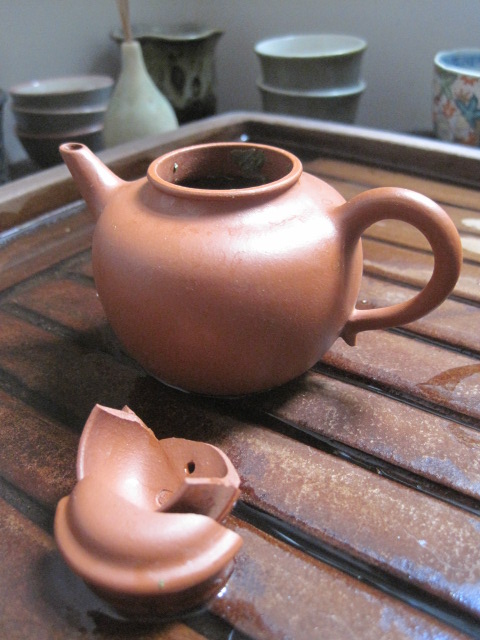
Here's what the first pot I ever bought looks like after a moment of spaciness this afternoon:

 
It's always the handy ones that get busted.  Why not one of the pots of no account that I sometimes consider throwing against the sidewalk- just so I don't have to be reminded that I spent hard-earned cash on them?  Oh yeah.  It's because I don't use them.  Woe unto any item of tea ware decent enough to be used by me with frequency.  For them, it is only a matter of time.  

I've not had much luck with gluing lids back together.  If anyone has a recommendation, I'm all ears.  

Bye bye 'lil oolong brewer.  Sniffley sniff.

Saturday, June 9, 2012

"Paradise Regained"

Well, that's overstating it a bit.  After some infernal sessions with the rebel angel's char-grilled oolong offerings, I've happened upon an upstanding Tie Guan Yin.  It is dark roasted, yet retains its essential character.  Thanks again to Mr. Erler.    

It's been a cool spring in Western Montana.  I'm a big fan.  But, all of these fresh spring tea samples are flooding in and they just aren't sitting well in my bundled-up body.  I'm left searching for something to stoke the internal furnace. 

                                                         
End of March


I bring attention to this TGY not because it is mind-blowing, but because there is a fundamental decency to it.  The roast is prominent but not at all overbearing.  Very pleasant, soothing and toasty.  Good sweetness and fairly long throaty aftertaste of dried cherries. It tastes like TEA, not a barbecue pit.  This TGY is reasonably priced for a well-stored 2008 tea.  ($25 for 100g)  I've paid more for TGYs that were far inferior.  I can see drinking this stuff very quickly as the clouds and rain hover.  
 

  "Let it rain, let it pour.  Let it rain a whole lot more, cause I've got those deep river blues."
                                              
--I wish to recognize the passing of the great Deep Gap, North Carolina musician Doc Watson who died at the age of 89 on May 29th.  Among Doc's many accomplishments is his signature version of "Deep River Blues," a tune originally performed under an alternate moniker by the Delmore Brothers.  A good tune for gray days.  Raise a cup for Doc!

Friday, May 25, 2012

Cinders

Do you ever wonder:  where's the tea amidst the roast?

Why do some aged oolongs resemble carbonized fragments left in the wake of a fire?

Dominic Point Fire, July 2010
It is my understanding that many folks periodically re-roast old oolongs to keep moisture out of the leaves.  If oolong sits around exposed to humidity, bad things can happen.  I've never experimented with long-term oolong storage, but I have soured my share of teas because I could not drink them fast enough and failed to protect them from the air.  Where does the sourness come from?  And why does this not happen with puerh which seems to require a modicum of humidity and air to age properly?

Some old, roasted oolongs retain something of their original essence and are quite complex and soothing like this 1994 Muzha Tie Guan Yin:


Time has been good to this tea.   I'm not sure if it was roasted more than once, but it was obviously handled well.  The roast is mildly noticeable and the tea is still intact.

On the other hand, this 1996 Ali Shan has been eclipsed by the roaster's hand.  The leaves hardly open, even after many infusions:


I am curious.  Why do some aged teas get over-roasted?  Is it because they were not very good to begin with and a heavy roast is an attempt to mitigate their mediocrity?  Did the roaster over-do it on accident?  Do some people like tea that tastes like charcoal?  Am I sometimes drinking teas that have been too recently re-roasted and which have not had time to settle?  My guess is that most of these hold true.  But my suspicion is that the primary issue is that it takes great care to age oolong in such a way that multiple roastings are not required.  Such oolongs, those that were high quality to begin with and that have been stored carefully and roasted with restraint, tend to be difficult and expensive to acquire.  One gets lucky now and again.  My guess is that a lot of the great tea from the past that was put aside for storage was kept for personal consumption and never sold.  

I welcome comments and thoughts about this phenomenon.  

Friday, May 11, 2012

On Using Enough Leaf: More Hong Shui Oolongs

When first starting to brew tea with attention, I had the tendency to shoot for maximum potency in brews.  Something about wanting the tea to make a grand impression on my senses, something about not being at all subtle.  I quickly learned to be more conservative when starting to experiment with young sheng puerh.  After a few nausea-inducing sessions, I changed my whole approach to tea and erred on the side of leaving plenty of open space in the pot for the leaves to relax and unfurl.  Insipid brews encouraged longer steeping times. 

But each tea requires its own peculiar parameters to coax it into giving up its best.  In the case of two more Hong Shui oolongs from the Lugu environs, a thicker brew proves better.  I acquired both teas from Stephane of Teamasters blog.        

One is a winter 2010 high mountain oolong from Feng Huang.  I had a few sessions with this tea and the finest was when I added a little extra leaf to the pot.  (Covering the bottom plus a small heap more)  The more leaf-laden brews yielded a bright fruit taste during the first few infusions that was either non-existent or subdued in more judicious leaf-to-water ratios.  Being over-generous with leaves might ravage the mouth and throat- as is the case with certain potent Bulang bings sourced by the Essence of Tea folks- then again one might just uncover something that was hidden before by pushing things a bit.

Here's this Feng Huang oolong with it's pretty winter-gold stems:


The other Hong Shui oolong was grown at lower elevations on Yi Guang Shan, which Stephane writes is halfway between the heights of Shan Lin Shi and the lower reaches of Zhu Shan.  This tea is quite affordable (half the price of the Feng Huang), and very smooth and pure.  I often dislike the lower elevation Taiwan oolongs.  More often than not they seem a bit empty of anything other than a candy-sweet quality that I find unpleasant.  Not so with this tea. While it lacks the content of the Feng Huang and the Shan Lin Shi that I wrote about earlier, it has a soothing honeyed fruit flavor that is greatly enhanced when a decent amount of leaf is used.

Yi Guang Shan
 Thanks to Stephane and the farmers for the abundance of pleasure they have provided through the years.

ALOT of strawberry plants grown with garlic to ward off insects in Zhunan, Miaoli CO.


Saturday, May 5, 2012

Shan Lin Shi

In the early spring of 2010, we had the good fortune to stay with the Chang family in Lugu, Nantou County, Taiwan.  We met the family through WWOOF Taiwan, a branch of the well-known organization that links organic farmers with folks interested in working in the dirt in exchange for room and board.  The Chang family has a plantation on Shan Lin Shi and a small organic oolong grove near their place in Lugu.  We were early for the tea harvest (and probably wouldn't have been much help anyway with our clumsy laowai picking fingers), but the Changs kindly invited us to visit for a couple of days anyway.  We shared some delicious meals and fabulous tea sessions and we deeply enjoyed the company--especially that of the hilarious and mischievous Miss Chang.

On a bright morning we drove out of the dewy valley where Lugu perches and entered the crystalline realm of Shan Lin Shi.  

Those spindly forms among the tea shrubs are ginkgo trees said to be planted at the behest of the Taiwanese government to mitigate erosion.  Our tea friend and guide, Miss Chang, told us that farmers plant ginkgos because they grow slowly and therefore do not compete with the tea plants.
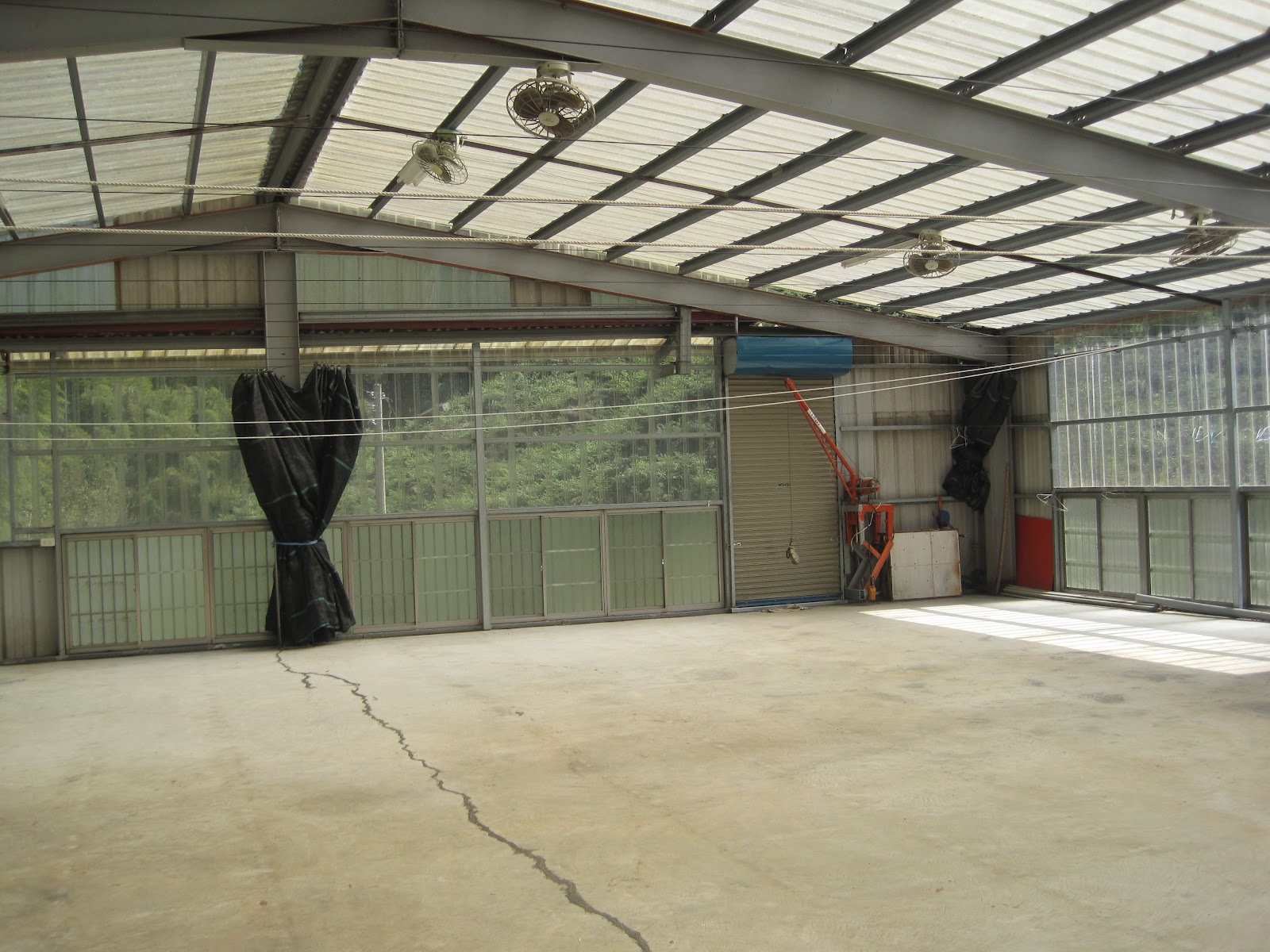
Shan Lin Shi is one of Taiwan's major high mountain oolong production areas and tea farms are tucked into the folds and contours of the mountain.  The tea plants were dark green, waxy and sleeping.  At the Chang's quiet processing center, we saw where fresh stem-and-leaf sets are sun-withered.  Lines above the withering area held a transparent awning that could be drawn to shield the tea in case the sun's rays become too piercing.   


           Indoor withering room where leaves are stirred and rested after outdoor wilting.
Indoor Wilting Baskets
                 
I do not recall the intricacies of the wilting, drying, rolling and roasting process these tender leaves are put through.  I do know that creating a fresh tea with the proper oxidation level and moisture content is not a simple endeavor.  We also got a look at ovens that remove moisture from the leaves.
                                                                  
Drying ovens 
                                                                  
How do they get those leaves and stems into such tight little balls?  


Rolling press
                                                                                             
While in Taiwan, we got the sense that large-scale high mountain oolong agriculture can be hard on the land.  (Like industrial agriculture in the central United States and elsewhere) It depends upon the approach of the grower.  Some farmers apply a lot of pesticides to their tea plants and have installed permanent structures that hold applicator tubing.  

Wish I had a better photo of it.  The  line dangling between two poles on the top right of the knoll is a hose that carries chemicals.
We spent a week with another WWOOF family in Zhunan (Miaoli CO) and our host, farmer Lin, a dedicated coffee drinker and skilled roaster, relayed his reservations with the gao shan oolong industry.  (He did so over a pot of Alishan)  Since Taiwan's mountainous core is so steep, he said, the pesticides used on high-grown tea wash downslope and contaminate the island's streams, valleys and the densely populated outer lowlands.  Add to this an increased tendency to erosion brought about by replacing native vegetation with relatively shallow-rooted young tea plants, and it is easy to see that many of the fresh teas I love to drink come with a cost.  Farmer Lin's notion seemed quite plausible to me, especially after taking a bus from Chiayi to the interior and seeing the effects of the August 2009 typhoon that sent mountains sliding everywhere.  

Farmer Lin's artfully rendered and conscientiously sourced oolong alternative.

Where does that leave the helpless gao shan oolong addict?  Trapped between the leaf and his conscience?  As a North American and a denizen of a region most suited to growing wheat, hay and black cherries I consider it a luxury to have access to Shan Lin Shi tea.  I am far from perfect in this department, but after visiting Taiwan and China, I feel compelled to try and support tea vendors who pay attention to how the tea they sell is grown.

In addition to stunningly delicious teas, the flanks of Shan Lin Shi produce other, equally scrumptious fruits of the soil.

Bamboo shoots!
Miss Chang's grandmother digging shoots on the mountainside.
Thanks to the Chang family for such fine days.